The startup investment game was never designed to include you. It was designed to include people who were already wealthy, already connected, and already inside the room.
If you've ever looked at a startup that went from nothing to a $1 billion valuation and thought — 'I wish I could have been part of that' — you're not alone. Billions of people around the world feel the same way.
The frustrating truth is that the opportunity was there. The startups were there. The potential returns were there. What wasn't there was a system that let ordinary people participate.
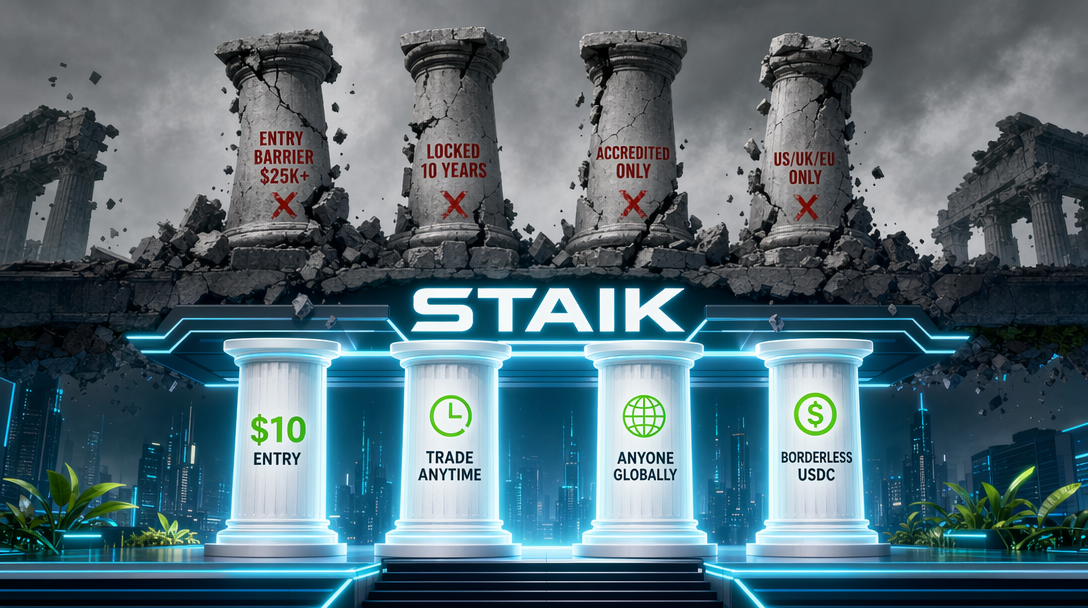
That wasn't accidental. The traditional startup investment ecosystem was built on structural foundations that — by design or by default — excluded retail investors. This article breaks down the four core failures of that system and explains exactly how Staik is dismantling each one.
Failure #1 — The Entry Barrier That Excluded 99% of People
Let's start with the most obvious problem: money.
In traditional startup investing, the minimum check size to participate in an angel round is typically $10,000 to $25,000. For a Series A? Often $50,000 to $250,000. Venture capital funds have minimum commitments of $250,000 to $1,000,000 or more.
These numbers weren't set arbitrarily. They existed because of the administrative cost of managing a large number of small investors in a private company — legal paperwork, cap table management, investor communications, and regulatory compliance all cost money, and they cost roughly the same whether you're managing a $10 check or a $100,000 check.
The result: an asset class that generated some of the most spectacular wealth in modern history — Uber, Airbnb, Stripe, SpaceX — was available only to those who could write six-figure checks.
📊 By the numbers: Only 13% of US households qualify as accredited investors under current SEC rules. Outside the US, the percentage is far lower. The remaining 87% — and nearly the entire global population outside developed markets — were structurally excluded.
How Staik fixes it: Staik uses blockchain tokenization to eliminate the administrative overhead that made small investments unviable. By converting startup shares into Digital Ownership Tokens (DOTs), the cost of managing one investor's stake is the same whether they invest 10 USD or 10,000 USD. The minimum investment on Staik is 10 USD. The barrier isn't just lowered. It's essentially removed.
Failure #2 — The Liquidity Trap That Locked In Capital for a Decade
The second structural failure is more insidious than the first — and arguably more damaging to the people who were able to participate.
When you invest in a traditional startup, your money is locked. There is no exchange. There is no market maker. There is no mechanism to sell your stake before the company either goes public (IPO) or gets acquired. You simply wait — and hope.
The average time from startup founding to IPO has grown significantly over the past two decades. In the 1990s, companies went public in 4–5 years on average. Today, the median is closer to 10–12 years. Many successful startups never go public at all — they get acquired, which may or may not result in a meaningful payout for early investors.
This illiquidity creates several serious problems:
• Capital risk: Your money is completely inaccessible if you need it — for emergencies, better opportunities, or life events.
• Concentration risk: With high minimums and long lockups, most investors can only afford one or two startup bets, making diversification impossible.
• Information asymmetry: You have no way to react to bad news about the company — you're stuck regardless of what you learn.
• Opportunity cost: Capital tied up in one illiquid startup can't be deployed into better opportunities that emerge over a decade.
💡 Key insight: Illiquidity isn't just inconvenient — it fundamentally changes the risk profile of an investment. An illiquid $10,000 investment in a startup carries far more real-world risk than a liquid $10,000 investment in public equities, because you cannot exit under any circumstance.
How Staik fixes it: The Staik Exchange is a trading platform built specifically for startup DOTs. From Day 1, investors can trade their tokens with other participants on the platform. You don't have to wait for an IPO. You don't have to wait for an acquisition. If you want to sell — you sell. If the company has grown in value and you want to lock in gains — you can. If you need liquidity for another reason — it's there. This single feature represents the most significant structural advancement in startup investing since the asset class was created.
Failure #3 — The Geographic Wall That Kept Out Most of the World
Here's a fact that rarely gets discussed: the majority of the world's venture capital activity is concentrated in three or four geographic clusters.
Silicon Valley accounts for approximately 30–40% of all US venture investment. Add New York, Boston, and a handful of other major hubs, and you've captured most of the market. Outside the US, London, Berlin, Singapore, and Tel Aviv account for the bulk of VC activity globally.
What does this mean in practice? If you're a startup founder in Lagos, Lahore, Lima, or Lusaka — you have dramatically fewer funding options than a founder in San Francisco. And if you're an investor in those same cities — the doors to most startup deals are completely closed.
This geographic concentration isn't because startups only exist in rich countries. It's because the infrastructure to connect capital with opportunity was built locally, not globally.
• Investors needed to be in the same city as the startup to build the trust required for private deals
• Legal structures for equity investment varied by country, making cross-border deals complex and expensive
• Currency friction made it difficult for international investors to participate in USD-denominated rounds
• Regulatory compliance across multiple jurisdictions made global fundraising prohibitively complex for most startups
How Staik fixes it: Staik's infrastructure is borderless by design. All investments are made in USDC — a dollar-pegged stablecoin that eliminates currency friction and works identically for an investor in Dubai, Delhi, or Detroit. Startups raise through a structured global entity that enables participation from investors in any country. An investor in Nairobi can invest in a startup in Berlin with the same ease as an investor in New York. The geographic wall doesn't just have a door now — it's been demolished.
Failure #4 — The Compliance Complexity That Made It Impractical
The fourth failure is less visible but equally important: the legal and regulatory complexity that made startup investing impractical for anyone without a team of lawyers.
Traditional startup investment involves:
• SAFE notes, convertible notes, or priced equity rounds — each with complex legal documentation
• Cap table management across dozens or hundreds of shareholders
• Different regulatory frameworks in every country (SEC in the US, FCA in the UK, SEBI in India, etc.)
• Investor accreditation verification and ongoing compliance
• Complex tax treatment that varies by jurisdiction and investment structure
Even for the accredited investors who cleared the financial barrier, navigating this complexity required professional legal and financial advice. For a retail investor in a developing market? It was effectively impossible.
How Staik fixes it: Staik uses the DIFO (Debt Instrument for Future Ownership) model — a purpose-built compliance structure designed to make startup investing legally accessible globally. Combined with a straightforward KYC process and a Belize-based parent company structure that enables international participation, Staik handles the regulatory complexity behind the scenes. Investors don't need lawyers. They don't need to understand securities law. They sign up, verify their identity, and invest.
The Broken System in One Picture
|
PROBLEM |
OLD SYSTEM |
STAIK'S FIX |
|
Entry barrier |
$10,000–$100,000 minimum |
Start from just 10 USDC |
|
Liquidity |
Locked 5–12 years, no exit |
Trade DOTs anytime on Staik Exchange |
|
Who qualifies |
Accredited investors only |
Anyone globally, after KYC |
|
Geography |
US, UK, EU — exclusive hubs |
Truly borderless, Tier 1–6 cities |
|
Funding model |
One-time campaign rounds |
Continuous, always-open fundraising |
|
Ownership proof |
Paper certificate/nominee |
On-chain Digital Ownership Token (DOT) |
|
Exit mechanism |
Wait for IPO or acquisition |
Sell on Staik Exchange — Day 1 |
Why This Matters Now — The Timing Is Everything
You might be wondering: if startup investing was so broken, why is it being fixed now and not 10 or 20 years ago?
The honest answer: the technology to fix it didn't exist until recently.
Tokenizing startup equity — converting shares into tradable digital tokens — requires blockchain infrastructure that is mature enough to handle real financial instruments at scale. That infrastructure became available in the last few years. The stablecoin ecosystem (USDC) that enables borderless investing at zero currency friction has only recently reached the scale needed for a platform like Staik to operate on.
The timing matters for investors. When a market transitions from inaccessible to accessible, the early participants capture a disproportionate share of the value created in that transition. The people who started investing in public equities through online brokers in the early 2000s — before the democratization of stock investing was complete — positioned themselves for the bull markets that followed.
⚡ The window: We are at the very beginning of the tokenized startup investing wave. The infrastructure is ready. The platforms are launching. The regulatory frameworks are forming. The investors who start now are the ones who will have the most to gain as this market matures over the next decade.
What Staik Is Building — The Full Picture
Staik isn't just patching the broken system. It's building a new one from the ground up — one designed from the start to be:
• Continuous: Startups raise capital on an ongoing basis, not in discrete campaign windows. This means more startups can access funding and investors can always find opportunities.
• Liquid: The Staik Exchange gives investors a real exit mechanism from Day 1. Startup investing, for the first time, comes with liquidity.
• Global: USDC-denominated, blockchain-native, and structured for international participation. No geography filter.
• Accessible: 10 USDC minimum. No accreditation required. No legal complexity. Sign up, verify, invest.
• Transparent: On-chain ownership through DOTs means your investment is verifiable and tamper-proof. No nominee structures, no paper certificates in a lawyer's filing cabinet.
Who Can Invest on Staik?
Anyone. That's not marketing language — it's the literal answer.
Staik does not require accreditation. It does not require a minimum income or net worth. It does not restrict participation based on country of residence (subject to local regulations in certain jurisdictions).
The only requirements are:
• Complete KYC verification — a standard identity check that takes 5–10 minutes
• Have USD available to invest — minimum 10 USD per transaction
• Be of legal age to invest in your jurisdiction
That's it. The barriers that excluded 99% of people from startup investing for decades are gone.
Frequently Asked Questions
Was startup investing really this exclusive?
Yes. Pre-Staik, the vast majority of startup investment was accessible only to accredited investors — a designation that excludes around 87% of US households and an even larger percentage globally. High minimum investment sizes, geographic concentration, and legal complexity reinforced these barriers.
Is the Staik Exchange a real trading platform — or just a feature?
It's a real exchange. Investors can buy and sell DOTs (Digital Ownership Tokens) representing startup shares with other participants on the platform. This is the core feature that makes Staik fundamentally different from every traditional startup investment platform.
What is a DOT and how does it represent startup ownership?
A DOT (Digital Ownership Token) is a blockchain-based token where 1 DOT = 1 share in the issuing startup. It is recorded on-chain, held in your Staik wallet, and fully transferable. It represents real ownership — not a claim, not a nominee structure, not a promise.
What is the DIFO model and why does it matter?
DIFO stands for Debt Instrument for Future Ownership. It's a compliant investment structure designed by Staik that makes global, small-ticket startup investing legally viable. It handles the regulatory complexity that previously made startup investing inaccessible — so investors don't have to.
Can investors outside the US and Europe use Staik?
Yes. Staik is designed to be globally accessible. The USDC-based system eliminates currency friction, and the platform's structure allows participation from investors in markets that traditional VC platforms never served — including across Asia, Africa, the Middle East, and Latin America.
What are the risks of investing in startups on Staik?
Startup investing carries real risk. Most startups fail, meaning some investments may go to zero. DOT prices are subject to market sentiment. While the Staik Exchange provides liquidity, trading volume for specific tokens may vary. Invest only what you can afford to lose, diversify across multiple startups, and take a long-term view.
The Old System Was Broken. Staik Isn't.
Invest in real startups from $10. Own actual shares. Trade anytime. No lock-in.
Start investing today at staik.co →