
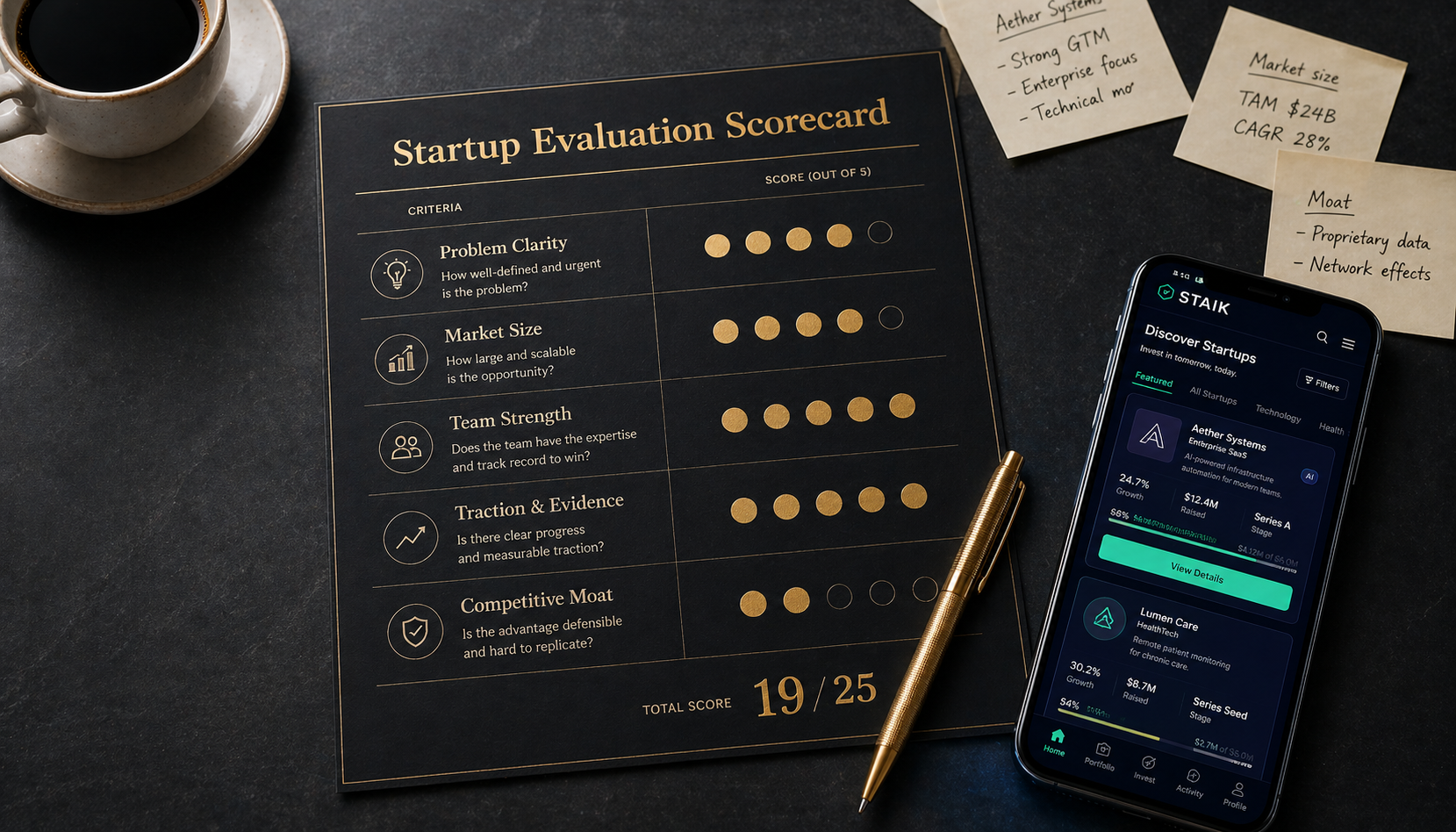
Most people pick startups the same way they pick lottery numbers — gut feeling, a good story, and a hope that something sticks. There's a better way. It takes about 20 minutes per startup. Here's exactly how to do it.
One of the most common questions from new investors on Staik is some version of: "I can see all these startups listed — but how do I actually know which ones are worth investing in?"
It's a fair question. And the honest answer is that no one can tell you with certainty which startups will succeed — not VCs with decades of experience, not the founders themselves. Startups are inherently unpredictable.
But there's a big difference between blind guessing and informed judgment. Experienced investors don't pick startups based on gut feeling alone — they use a structured evaluation process that identifies the characteristics most commonly associated with startup success. Then they invest in many companies across that framework, knowing some will fail but betting that enough will succeed to generate real returns.
This article gives you that framework — simplified for a retail investor making a $10 to $100 decision, not a VC writing a $5 million check.
Why Evaluation Matters Even More at Small Investment Sizes
You might think: "I'm only investing $10 — does it really matter how carefully I evaluate it?" It matters more than you'd think, and here's why.
The purpose of evaluation isn't just to protect your individual $10. It's to build investing instincts. Every startup you evaluate — whether you invest or not — teaches you something about what good looks like. Over time, your pattern recognition improves, your portfolio quality improves, and your returns improve with it.
Investors who evaluate carefully from the start tend to build better portfolios than those who invest casually across many startups without thinking. The process is the practice.
💡 The rule I use: spend at least 20 minutes evaluating any startup before investing, regardless of how small the amount. If a startup can't hold your attention for 20 minutes of research, it probably doesn't deserve your money for 5 years.
The 5-Point Startup Evaluation Framework
This framework covers five areas that research and experience consistently identify as the most predictive of startup success. Each is scored out of 5, giving a maximum total score of 25.
The decision rule: Only invest in startups that score 15 or above out of 25. Below 15 means too many fundamental questions remain unanswered.
01 |
Problem Clarity |
Does the startup solve a real, clearly defined problem that enough people actually have? Vague problems produce vague solutions. The best startups can state the problem in one sentence and show you evidence that people are experiencing it right now. Ask: Can I explain the problem this startup solves in one sentence? |
02 |
Market
|
Is the addressable market large enough to support a meaningful business? A startup solving a real problem in a market of 10,000 people has a low ceiling. The best investments are in markets large enough that capturing even 1% of them creates a significant company. Ask: How many people have this problem, and what would they pay to solve it? |
03 |
Team Strength |
Does the founding team have the relevant experience, skills, and determination to execute? More startup failures come from team problems than idea problems. A great team with a mediocre idea will often outperform a mediocre team with a great idea. Ask: Why is this specific team the right one to solve this specific problem? |
04 |
Traction & Evidence |
Has the startup already shown that people want what it's building? Early traction — paying customers, user growth, letters of intent, pilot programmes — is the most honest signal that a startup is solving a real problem. Talk is cheap. Revenue is honest. Ask: What evidence exists that real people are using or paying for this? |
05 |
Competitive Moat |
Does the startup have something that makes it hard to copy? A good idea with no moat gets replicated by a larger competitor with more resources. The moat could be proprietary technology, network effects, exclusive partnerships, brand, or regulatory advantage. Ask: If this idea works, what stops a bigger company from copying it? |
The Weighted Scorecard
Not all five criteria are equally important. Here's how to weight them:
|
CRITERIA |
WEIGHT |
SCORE |
|
Problem Clarity |
20% |
5 |
|
Market Size |
20% |
5 |
|
Team Strength |
25% |
5 |
|
Traction & Evidence |
25% |
5 |
|
Competitive Moat |
10% |
5 |
Team Strength and Traction carry the most weight for a reason. The team is the single most predictive factor in early-stage startup success — more predictive than the idea, the market, or the technology. And traction is the one criterion that's hard to fake. Either people are using and paying for the product, or they aren't.
How to Score Each Criterion (1–5 Guide)
Problem Clarity (1–5)
1: The problem is vague or hypothetical — "people want better productivity tools"
2: Real problem but poorly defined or very niche
3: Clear problem, reasonable evidence it exists, moderate size
4: Well-defined problem with strong evidence and a large affected population
5: Crystal-clear problem, widely documented pain, compelling market data, and you personally understand why it hurts
Market Size (1–5)
1: Extremely niche — fewer than 100,000 potential customers globally
2: Small market — enough for a lifestyle business, not a venture-scale company
3: Moderate market — $500M to $2B addressable
4: Large market — $2B to $20B addressable
5: Massive market — $20B+ addressable, global potential
Team Strength (1–5)
1: First-time founders with no relevant experience or domain expertise
2: Some relevant experience but clear skill gaps in key areas
3: Credible team with relevant backgrounds, at least one domain expert
4: Strong team with direct experience in the industry and complementary skills
5: Exceptional team — prior startup success, deep domain expertise, and clear reason why they specifically will win
Traction & Evidence (1–5)
1: Idea only — no product, no users, no evidence of demand
2: MVP exists but no paying customers or meaningful usage
3: Early users or pilot customers, some engagement data
4: Paying customers, growing user base, clear revenue trajectory
5: Strong revenue growth, high retention, clear product-market fit signals
Competitive Moat (1–5)
1: No obvious moat — any competitor could replicate this tomorrow
2: Some first-mover advantage but nothing structurally defensible
3: One clear moat — proprietary data, or a key partnership, or early network effects
4: Multiple moats or one very strong one — hard to replicate without significant time and resources
5: Exceptional defensibility — strong network effects, regulatory moat, or technology patent that creates a genuine barrier to entry
Red Flags and Green Flags
Beyond the scorecard, there are signals that should immediately raise or lower your confidence regardless of how a startup scores on the five criteria.
|
🚩 RED FLAGS — PAUSE AND RECONSIDER |
✅ GREEN FLAGS — STRONG POSITIVE SIGNALS |
|
• Founders who can't clearly explain what they're building |
• Founder personally experienced the problem they're solving |
How to Apply This Framework on Staik
When you browse startup listings on Staik, each company's listing page gives you the information you need to run this scorecard. Here's where to find each data point:
• Problem Clarity: The company's pitch summary — read the first three paragraphs. If you can't explain the problem after reading them, score low.
• Market Size: Often stated in the pitch as a market size figure. If it's not stated, look up the industry independently and form your own view.
• Team Strength: Founder bios and backgrounds. Look for relevant industry experience, prior entrepreneurship, and technical depth in the area the product requires.
• Traction & Evidence: Revenue figures, user counts, customer testimonials, or pilot programme data. This is the section to scrutinise most carefully.
• Competitive Moat: The "why us" section of the pitch. Be sceptical of generic answers. Look for specific, concrete advantages that would be hard for a competitor to replicate.
⚠️ Honest reminder: Even a startup that scores 25/25 on this framework can fail. This framework helps you identify stronger opportunities and avoid obvious mistakes — it doesn't predict the future. Diversification across multiple startups remains the single most important risk management strategy, regardless of how carefully you evaluate each one.
A Quick Worked Example
Let's say you're evaluating a healthtech startup that helps elderly patients manage medications through a smartphone app. Here's how you might score it:
• Problem Clarity (4/5): Medication mismanagement in elderly patients is a well-documented, significant problem with strong evidence. Slightly dinged because smartphone penetration in elderly demographics is lower than ideal.
• Market Size (4/5): Global elderly care market is enormous. Addressable market for digital medication management tools is large and growing.
• Team Strength (3/5): Two founders — one with healthcare experience, one with mobile app experience. Strong combination but no prior startup success.
• Traction (3/5): 200 paying users in a pilot with a regional hospital. Small but meaningful — a hospital paying is a strong signal.
• Competitive Moat (2/5): The app itself isn't hard to build. The moat would come from hospital partnerships and data — but those aren't established yet.
Total: 16/25. Scores above the 15/25 threshold — a qualified investment candidate. You'd want to dig deeper into the team's plan for building moat over time before committing significant capital.
Frequently Asked Questions
Do I need financial knowledge to use this framework?
No. The framework is designed for complete beginners. Each criterion uses plain language and the scoring guide gives concrete examples of what a 1, 3, and 5 looks like. No accounting or financial modelling skills required.
How long does it take to evaluate a startup using this framework?
About 20–30 minutes per startup for a beginner. With practice, you'll develop pattern recognition and the process gets faster. Some investors eventually run through the scorecard in 10 minutes for obvious cases.
What if a startup scores below 15 but I still believe in it?
The 15/25 threshold is a guideline, not a hard rule. If you have specific knowledge or insight that the framework doesn't capture — for example, you work in the industry the startup serves — you can weight your judgment accordingly. The framework is a thinking tool, not a veto.
How many startups should I evaluate before investing?
Evaluate at least 5–10 startups before making your first investment. This gives you a comparative baseline — what a strong team looks like versus a weak one, what compelling traction looks like versus minimal traction. The comparisons sharpen your judgment significantly.
Can I apply this framework to startups on Staik?
Yes — this is exactly what it's designed for. Each Staik startup listing contains the information needed to score all five criteria. The article above maps each criterion to the relevant section of a Staik listing page.
What's more important — a great idea or a great team?
Almost universally: a great team. Ideas pivot constantly during the life of a startup. Markets shift. What stays constant is the quality of the people executing. A great team finds a way. A weak team fails even with a great idea. That's why Team Strength carries the highest weight in this framework.
Ready to Put the Framework to Work?
Browse real startup listings on Staik, run the scorecard, and invest from $10 in the ones that make the cut. Your first evaluation takes 20 minutes. Your first investment takes 2.
Browse Startups on Staik →